
Heavy Copper PCB RFQ: Resolve Copper, Geometry and Thermal Conditions Before Quotation
A heavy copper quote needs consistent copper-by-layer requirements, manufacturable geometry and defined electrical and thermal conditions.
“Heavy copper” alone is not a quotation specification. A design may show a wide power rail but omit the finished copper requirement. Its drawing and stackup may use the same ounce value differently. Identify what is fixed, provisional or open for engineering review before pricing.
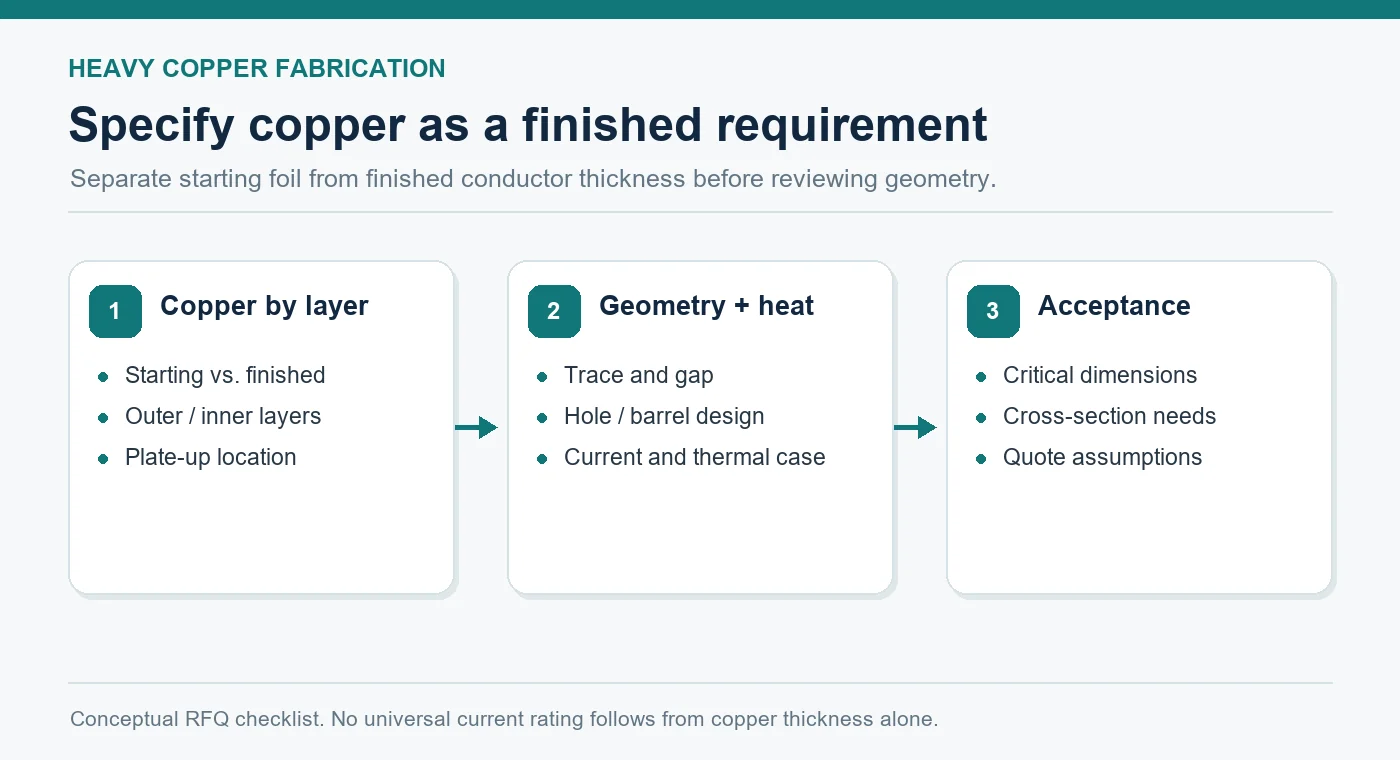
When the drawing and stackup say “6 oz” differently
Imagine a drawing calling for “6 oz copper” on the outer layers, while the stackup labels 6 oz as starting foil. These do not necessarily describe the same finished conductor. Outer-layer plating and processing affect thickness; inner layers may follow a different route. Provide a layer table separating starting foil, required finished conductor thickness, and nominal versus minimum acceptance values. State units and surface finish separately.
If documents conflict, flag the discrepancy. The base-versus-finished copper guide explains the definitions; this RFQ must resolve the customer-approved value for each layer.
When a wide power bus shares a layer with fine features
A broad bus may share a layer with closely spaced control traces, pads or tight connector clearances. Thicker copper changes achievable trace and gap geometry. The narrowest features and copper distribution matter as much as bus width.
Send actual CAD minimum line width and gap, copper-to-hole and copper-to-edge clearances, critical pads, and layer images. Mark immovable features. The manufacturing partner's CAM review can check copper construction against etch compensation, plating and finished geometry. A generic capability statement cannot approve a dense area. Customer approval is needed for revised data.
When the current path narrows at a hole or connector
The wide rail is not the whole current path. A plated hole, via array, component pad or connector neck-down changes conductor cross-section and heat flow. Specifying only surface copper leaves critical transitions undefined.
Identify current-carrying layers and their transitions. Provide finished hole diameters, via locations and counts, annular rings, and any minimum hole-wall copper or inspection requirement. Outer-surface copper does not prove the hole barrel meets a separate requirement. The manufacturing partner reviews drilling and plating feasibility; the product designer evaluates electrical and thermal behavior.
Define the operating conditions behind the current target
“Carry 30 A” is incomplete without duty cycle and thermal conditions. State whether current is continuous, peak or pulsed; ambient or enclosure conditions; allowable conductor temperature rise; and component or connector limits. Show heat-spreading paths through adjacent planes, mounting metal or airflow. Include voltage-drop limits if they govern width.
IPC-2152 relates finished-board conductor size to current and acceptable temperature rise; it does not turn copper weight into a universal amperage rating. Geometry, layer position, nearby copper and cooling affect the result. Validate the intended operating condition in the assembled product.
Quote and inspect against one approved package
Send one controlled revision of the drawing, copper and drill data, stackup, layer-by-layer copper table, quantity and target delivery. Specify the acceptance class or customer standard and any microsection, hole-wall measurement, electrical test or first-article record. Agree sampling locations and pass criteria before production.
MWX PCB checks file completeness and coordinates open questions. The assigned manufacturing partner confirms process feasibility and inspection conditions; the customer approves design changes and acceptance limits. Keep unresolved copper, line-space or thermal assumptions explicit in the quotation.
See heavy copper PCB manufacturing for product scope. No final Gerbers yet? You may still submit an RFQ with the outline, layer count, expected copper by layer, current-path sketch, quantity and open questions. File upload is optional; production conditions need final manufacturing data.
BACK TO TECHNICAL ARTICLES