
RF PCB Manufacturing RFQ: Resolve Material, Stack-Up and Test Scope Before a Quote
Align RF laminate grades, hybrid stackup, impedance geometry and test scope before requesting a manufacturing quote.
An RF PCB request can look complete while describing two different builds. The drawing may name RO4350B, the purchasing note may allow “Rogers or equivalent,” and the impedance table may assume an outdated dielectric thickness. Before quotation, separate fixed requirements from items open to engineering review. This example is illustrative, not a customer project.
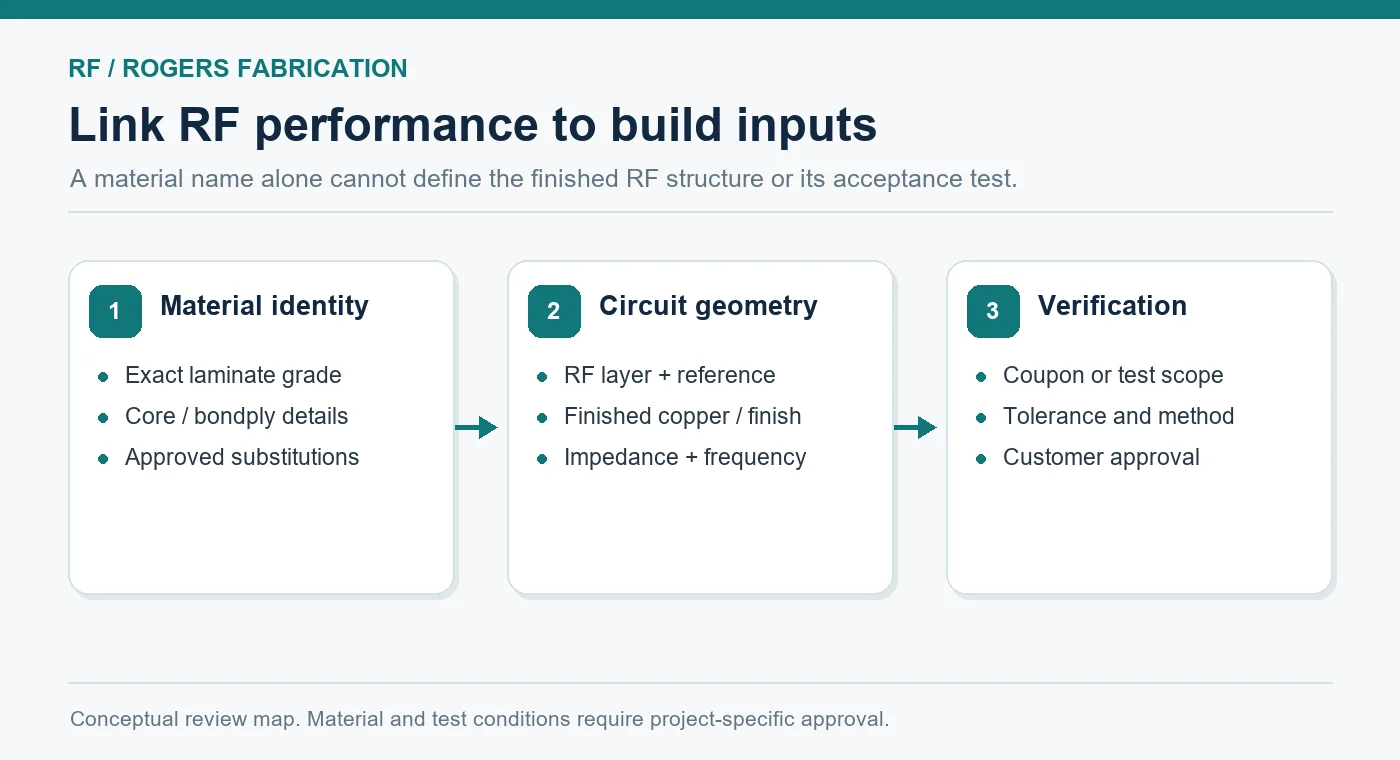
Decide what the material callout actually permits
“Rogers PCB” is not a complete material specification. If the design calls for RO4350B, identify the RF core grade and thickness, copper type or profile if controlled, and any specified bonding material. Mark whether an alternative grade or construction is prohibited, permitted for engineering proposal, or already approved. A nominal Dk match by itself does not authorize a substitution; the existing Rogers laminate selection article explains why material values need their test conditions.
For example, a drawing requires RO4350B on the RF signal layer while an email says “equivalent acceptable.” These conflict until the customer states who may approve a change and which electrical, mechanical or compliance requirements must remain. The quote can show a base construction and, if requested, a separately reviewed alternative.
Make the hybrid stack-up a buildable proposal
An RF/FR-4 hybrid board needs more than a layer count. Show the layer order and identify the cores and bonding layers beside each RF trace and reference plane. Include dielectric thicknesses, copper requirements, finished board thickness, via spans and critical registration or flatness requirements. Rogers describes RO4000 materials used with FR-4 layers, but bonding and manufacturing sequence remain project decisions.
Suppose a six-layer concept places the RF trace on layer 1 over a ground plane on layer 2, while the general-purpose layers use FR-4. If a revised stack-up changes the L1-to-L2 dielectric or bonding layer, the original RF geometry may no longer represent the intended circuit. Record the proposed change and send it for design approval before treating the new construction as released. Our RF and microwave PCB manufacturing page outlines the engineering review scope.
Connect impedance to the revised geometry
An impedance target without routing layer, reference plane and trace geometry is difficult to price or verify. Provide controlled nets or classes, targets and required tolerances, fixed line and space, and whether conductor thickness means starting foil or finished copper. Identify the design frequency range if relevant. If the manufacturing partner proposes different dielectric or copper, request the revised stack-up and trace geometry together.
A useful engineering question is specific: “Can this L1 line retain its approved width with the proposed RO4350B-to-ground construction, or does the width need design approval?” It is more actionable than “please guarantee 50 ohms” without a layer reference. The partner’s engineering team must confirm feasibility for the actual files and process.
Define what “RF tested” means before pricing
An impedance coupon, continuity test and RF insertion-loss measurement answer different questions. If RF performance testing is required, state the parameter, frequency band, acceptance limit, test structure or board location, specified fixture or de-embedding requirements, sampling quantity and report format. If no RF test is required, say so; “100% tested” should not imply an unquoted measurement.
Consider a drawing that calls for insertion-loss data but gives no frequency range or test coupon. The quotation cannot responsibly assume a measurement method or an acceptance threshold. The open item should remain visible until the customer and manufacturing partner agree on a measurable requirement and test scope. Material datasheet figures are material references, not finished-board guarantees.
Send a reviewable RFQ even when files are provisional
MWX PCB can check submitted information and coordinate questions; the assigned manufacturing partner confirms feasible stack-up, process, inspection scope and quote conditions. State the part number and revision, quantity and expected follow-on volume, material restrictions, target date and open decisions. When released, send matching fabrication data, drill files, stack-up drawing and test notes.
If Gerber files are not final, use the RFQ form to describe the project and unresolved items now; file upload is optional. If an NDA is required before sensitive files are shared, say so in the project details. A quote based on confirmed conditions is more useful than a price built on unapproved substitutions or unspecified RF tests.
BACK TO TECHNICAL ARTICLES